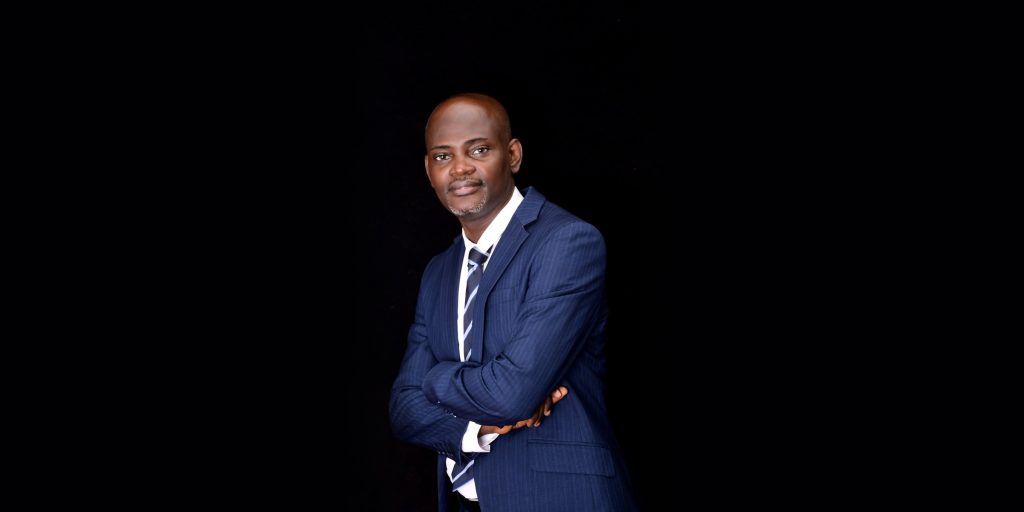
How an uncertain beginning, unexpected opportunities and a passion for communication shaped the career of a university researcher and administrator
For Albert Anani-Bossman, success did not begin behind a university desk.
It began in New Takoradi, a suburb of Takoradi in Ghana’s Western Region. Today, he is a senior academic and serves as Director of Research, Innovation and Development at the University of Media, Arts and Communication (UniMAC).
But the journey from New Takoradi to university leadership was far from straightforward.
From New Takoradi to Accra
Dr Anani-Bossman spent his early childhood in New Takoradi. Those years were not centred on academics. According to him, education was not taken very seriously around him at the time, and he often found himself away from school.
“I was mostly going around selling vegetables more than schooling,” he recalled.
His parents were outside Ghana at the time. In 1988, his aunt brought him to Accra. That move became an important turning point in his life. It was in Accra that his educational journey began to take a different direction.
Finding Communication
Dr Anani-Bossman first studied English and Linguistics. At that point, however, he was uncertain about the career path he wanted to follow.
While considering what to study at postgraduate level, he came across Communication, and the field immediately caught his attention.
Some people thought he would make a good lawyer, but he knew that was not the path for him. He describes himself as naturally reserved and saw something in communication that suited his personality and interests.
He pursued a Postgraduate Diploma at the School of Communication Studies before going on to complete his Master’s degree.
Interestingly, his entry into Public Relations was also not something he had planned.
During his postgraduate studies, a friend introduced him to Mr Kojo Yankah, then Chief Executive of Yankah & Associates and President of what was at the time the African Institute of Journalism and Communication.
He was offered an internship. After three months, his work impressed the organisation enough for him to be offered a permanent position. That opportunity became the beginning of his professional journey in Public Relations.
Learning Through Experience
Dr Anani-Bossman’s career was built largely on learning by doing.
He worked in consultancy for several years, including with Stratcomm Africa and later another consultancy, while also gaining teaching experience.
At one point, he believed academia might offer a less demanding life than consultancy.
“I thought, maybe academia will be easy,” he said.
He would soon discover otherwise.
In 2011, an opportunity at Pentecost University opened the door to full-time academia. He became one of the first lecturers in the university’s communication department.
His move into academic leadership was equally unexpected. When the head of department resigned during a difficult period, there was no immediate replacement, and Dr Anani-Bossman was asked to take on the role.
The department was facing a serious challenge. Some students could not graduate because of an affiliation issue, and the situation eventually led to legal action. At the same time, the programme was due for reaccreditation.
He therefore had to run the department while dealing with the crisis and working on the accreditation process.
“The first two years, in particular, were quite tough,” he recalled.
The experience, however, became an important period of professional growth. He credits his earlier corporate experience with helping him handle the pressure.
Research and Leadership at UniMAC
Today, his responsibilities extend beyond teaching.
As Director of Research, Innovation and Development at UniMAC, his work focuses on strengthening the university’s research environment and giving research by faculty members greater visibility.
His initiatives include partnerships with international conference organisers, a research database and directory, research and ethics policies, and the operationalisation of research ethics review boards.
He also supports faculty members with research training, publication strategies, identifying credible journals and finding opportunities for grants and sponsorship.
His role brings him into contact with students, lecturers, researchers and external institutions.
The work is demanding, but for him the goal is clear: to create an environment where research at UniMAC gains greater recognition, both locally and internationally.
Why Public Relations in Africa?
In 2023, Dr Anani-Bossman co-edited Public Relations Management in Africa, a two-volume book published by Palgrave Macmillan.
One of his motivations was what he saw as a gap in existing academic resources. Much of the material used in Public Relations education, he observed, was produced from Western perspectives. It did not always reflect African cultural and environmental realities.
His goal was therefore to contribute to literature that examines Public Relations from an African perspective. He wanted universities and students to have access to materials that reflect how Public Relations is actually practised within African societies.
For him, the issue goes beyond producing another academic book. It is about making sure African communication experiences and perspectives become part of the global Public Relations conversation.
The State of PR in Ghana
Dr Anani-Bossman believes Public Relations in Ghana has improved. Still, he sees one major challenge facing the profession: a lack of understanding of what Public Relations actually is.
He says organisations sometimes place people in PR positions simply because they can communicate, write or talk, or because they have experience in a related field.
“People feel that anybody can do PR,” he explained.
He believes this has led to Public Relations being treated largely as a technical or tactical function rather than a strategic management function. In his view, PR professionals should be involved in decision-making, environmental scanning, advising management and evaluating organisational outcomes.
Another problem, he says, is that PR professionals themselves sometimes fail to understand their own value.
For him, practitioners need to develop professional competence and, importantly, business acumen. A PR professional may not need to become an expert in the organisation’s industry. But they must understand how the organisation works and how communication contributes to its wider business goals.
“You need to understand the business in which you are,” he explained.
AI: A Tool, Not a Replacement for Human Judgement
Artificial intelligence has become central to Dr Anani-Bossman’s recent research.
He believes AI gives communication professionals powerful tools for brainstorming, generating ideas, creating content and producing visuals. However, he warns against becoming overly dependent on it.
AI can produce inaccurate information, misinformation and what is commonly called hallucinated content. For that reason, communication professionals must keep applying human judgement and verify information before publishing it.
He also believes AI cannot fully replace the cultural understanding that effective Public Relations requires. In Africa, where cultural nuances strongly shape communication, human judgement remains particularly important.
Ethics is another concern. Issues of plagiarism, copyright, accountability, transparency, misinformation and the responsible use of AI-generated content are becoming increasingly important.
His message to practitioners is not to fear AI, but to learn how to use it responsibly.
“Someone who knows how to use AI can replace you,” he noted. For him, the answer is to build AI skills rather than simply worry about machines taking jobs.
His Advice to Young PR Professionals
For young graduates entering Public Relations, Dr Anani-Bossman has a simple message: do not focus only on money at the start of your career.
When he started working, he earned only GH¢120 a month. But the salary was not his priority.
“I wasn’t thinking about the money; I was thinking about the experience I would gain,” he said.
He believes young professionals should focus on learning, developing their skills, understanding the industry and gaining practical experience.
He also encourages them to keep upgrading themselves, because communication is always changing. His own career shows this. He did not learn everything he needed at university. He taught himself areas such as technology and digital PR by researching and learning online.
Graduates, he says, should show that university has done more than give them a certificate.
“It’s not about you going through the university; it’s about how the university went through you and your ability to make an impact.”
Dr Albert Anani-Bossman
Beyond the Office
Despite his demanding responsibilities, there is a quieter side to Dr Anani-Bossman. He describes himself as someone who is not particularly interested in going out.
“I hardly go out. I’m not the outing type,” he said.
He prefers spending time indoors. And when he is not researching, teaching or handling his duties, he has an unexpected way of relaxing: watching cartoons. He is a fan of Japanese anime, particularly Bleach and Naruto.
“I just watch cartoons,” he said.
It is a surprisingly informal contrast to the image of a research director. But perhaps it also reflects the reserved personality he described earlier.
A Career Built on Growth
Dr Anani-Bossman’s story is ultimately one of growth.
He began as a young boy in New Takoradi who spent more time selling vegetables than attending school. He went on to become a student of English and Linguistics, a communication professional, a consultant, a lecturer, an academic leader and a research director.
His career has rarely followed a planned route. Opportunities appeared, challenges forced him to grow, and experience taught him what formal education could not always provide.
He once thought academia might be the easier path. Instead, it brought some of the toughest tests of his career, from leading a department through a crisis to building a university’s research culture.
His message to young communication professionals reflects that journey: learn, adapt, build your competence and focus on becoming valuable.
Today, his work is about more than communication itself. It is about helping the next generation of Public Relations professionals understand its value, practise it strategically and prepare for a rapidly changing world.
Have a view on Public Relations in Ghana? Write for PR Ghana and share it with the profession.
One response to “From Selling Vegetables to Shaping the Future of PR: The Journey of Dr Albert Anani-Bossman”
-
[…] other senior figures in Ghanaian Public Relations have been saying. In a recent PR Ghana interview, Dr Albert Anani-Bossman of UniMAC made the same point: “People feel that anybody can do PR.” He argued that […]



Leave a Reply